Product Spotlight: L1 – The New Benchmark for Concert Sound Systems Product Spotlight: L1 – The New Benchmark for Concert Sound Systems...
Every generation or so, a technology arrives that redraws the floor plan entirely. L-Acoustics introduced the modern line array in 1992 with V-DOSC, establishing the principles of line source design that the industry still builds on today. In 2008, K1 set the touring standard for more than 15 years, becoming one of the most trusted concert sound systems in the world. L1 is the next step in that lineage: it’s neither an iteration nor an update, but a genuinely new approach to what a line source system can do. Built for the world’s biggest stages, from stadium tours and arena productions to the largest festivals and flagship venues, L1 delivers scale and power while preserving the tonal integrity that connects audiences through the best shared sound at any scale. With a new level of control and system efficiency, L1 ensures an artist’s exact intent is what is delivered to the audience. And with consistent performance across the entire audience area, L1 enables repeatable excellence, show after show.
Built on a New Physical Principle
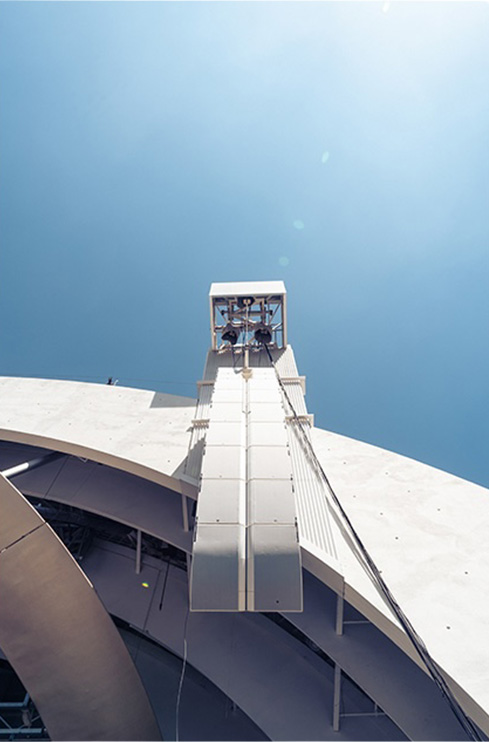
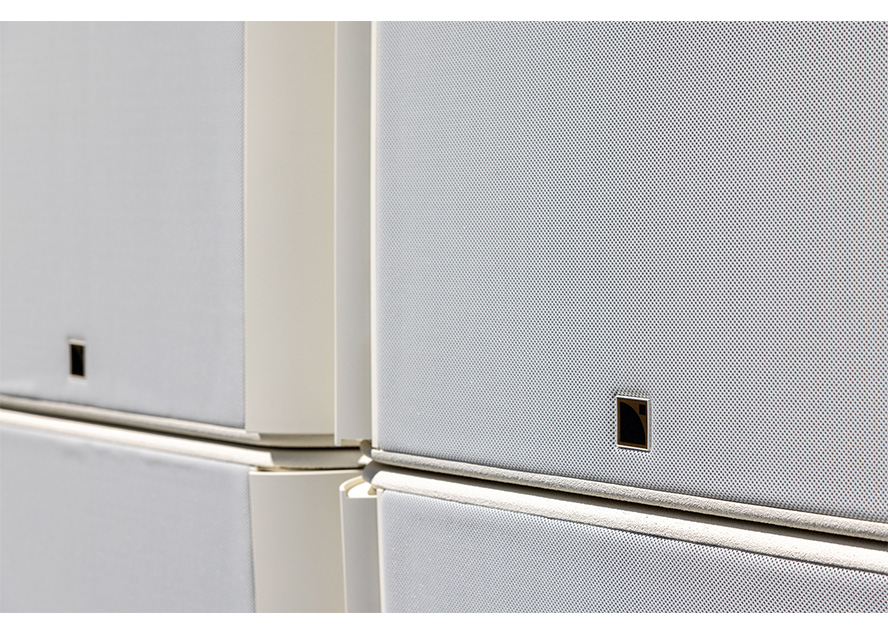
At the heart of L1 is Progressive Ultra-Dense Line Source technology, or PULS. The concept is straightforward in its ambition and demanding in its execution: maximize the active radiating surface of the enclosure to push maximum air volume and establish the best possible acoustic starting point.
PULS achieves a 100% active radiating factor (ARF) for a single enclosure and up to 99% across a full array. In practical terms, this means that nearly the entire enclosure face is doing acoustic work. Nothing is wasted. Combined with the high-resolution processing architecture of the LA7.16 amplified controller, which drives individual acoustic elements of L1 with precision across 16 output channels, the system gains a degree of control over energy distribution that has not previously been achievable at this scale. The result is a system that can shape sound precisely across the vertical and horizontal planes over the full frequency range, with a coherence and predictability that holds from the front row to the far field.
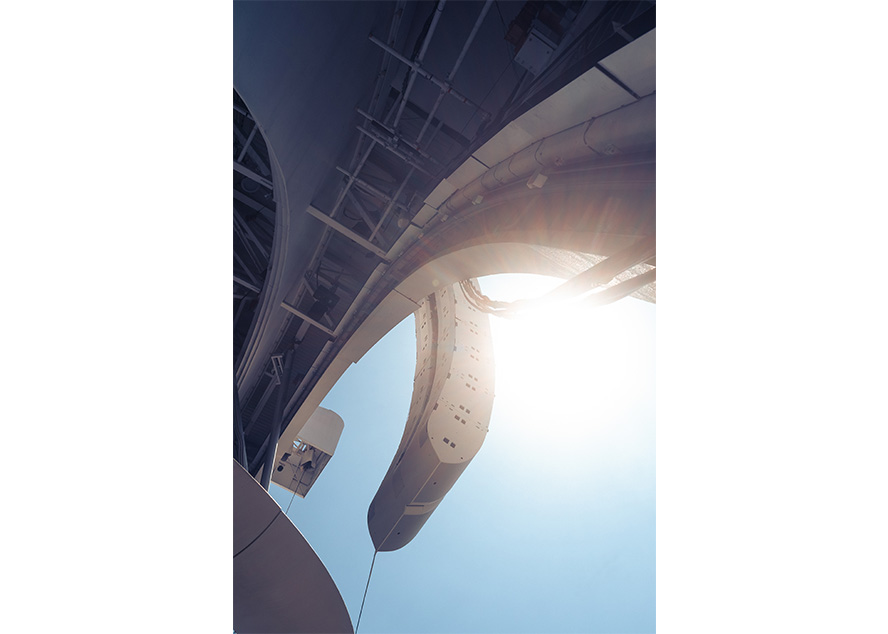
The L1 system comprises two enclosure types: L1 and L1D. Acoustically identical, they differ in their progressive curvature within the array. L1 is 0.8° for flat fields and 5° for stadiums and arenas, while L1D serves as the final element with a progressive 60° curvature to address the near field and complete the system’s vertical profile. From top to bottom, the system is built on the same core element, ensuring full acoustic consistency across the entire line.
Power, Redefined: A New Reference for Concert Sound Systems
L1 is the most powerful system ever developed in its class, setting a new reference across every meaningful metric: SPL, SPL/m, SPL/kg, and SPL/m2. Power at this level is defined by more than loudness alone; it is the ability to maintain tonal integrity and impact at scale.
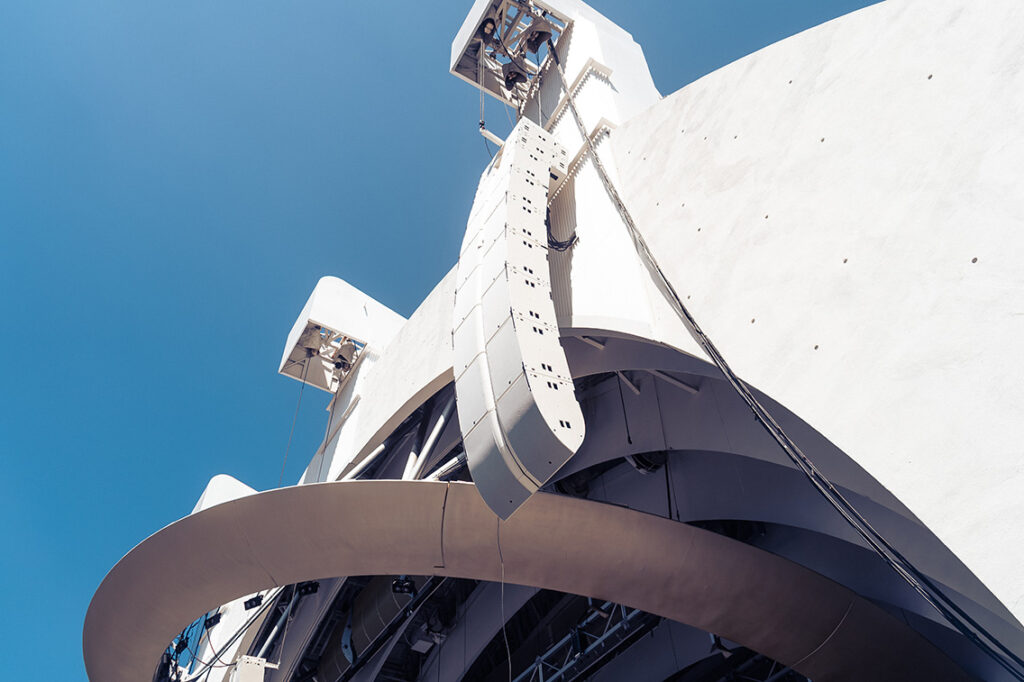
A ten-element L1 array delivers output that exceeds that of a thirty-element K1 array. In real deployments, an L1 array can be around 30% shorter than an equivalent K1 deployment while delivering greater power. That headroom creates meaningful options: smaller hangs for the same performance, or significantly larger configurations when a production demands it. Whether operating at moderate to high levels, L1 delivers consistent energy, clarity, and balance across the entire audience.
Control in Three Dimensions
Through PULS technology, a fixed progressive geometry combined with advanced electronic optimization allows the array to behave as a coherent, predictable acoustic system. This enables comprehensive pattern control in all three dimensions.
In the horizontal plane, Panflex provides precise directivity in the mid and high frequencies. A patented L-Acoustics technology, Panflex allows horizontal coverage to be configured directly on the enclosure by mechanically adjusting integrated fins connected to the waveguide, without tools or additional enclosures. On L1, it offers four directivity options within a single enclosure: symmetrical coverage of 70° and 90°, along with 80° asymmetrical configurations. The L1D element extends this range further, with 70° and 110° symmetrical options and 90° asymmetrical coverage.
The patented cardioid design of the L Series is based on precise driver alignment and acoustic control. In L1, four front-firing 15” LF drivers work with two side-mounted 18” cardioid drivers to project high-impact energy forward while achieving 18 dB attenuation behind. (25-250 Hz) This topology preserves strong frontal impact while reducing unwanted energy where needed. Users can select among cardioid, supercardioid, and enhanced side-rejection presets to adapt the system’s behavior to any environment.
In the vertical plane, the latest generation Autofilter shapes how low frequency energy is distributed along the length of the array, allowing it to behave like a significantly longer system with equal or greater control. Using FIR filters to achieve independent control of magnitude and phase, it delivers effective low frequency beam control down to 20 Hz, without additional latency. Every listener experiences the same balanced energy, from the front rows to the far field. All of this is integrated into the standard workflow and activated with a single click.
Efficiency at Every Stage, on Every Stage
Large-format concert sound systems have always carried a heavy operational cost. L1 was designed to reduce that cost without reducing ambition.
On tour, an L1 system needs as much as 20% less truck space and weight than an equivalent K1 system today, saving fuel, transportation costs and reducing the environmental impact.
An auto-lock rigging system is fully integrated into the enclosure, enabling fast and consistent assembly without external hardware and reducing setup time to around one third of a comparable captive rigging system. One LA7.16 amplified controller drives one L1 enclosure, delivering high-resolution DSP through 16 output channels. This one-to-one architecture simplifies system design and reduces cabling to a single connection, creating a cleaner and more efficient setup. The result is consistent performance with less time, fewer resources, and greater control, enabling repeatable excellence, show after show.
A Lineage That Earns the Ambition
L1 does not arrive without context. In 1992, V-DOSC introduced the world’s first modern line array and established the principles of line source design still in use today. In 2008, K1 expanded the scale and power of large-format concert sound systems and introduced the world’s first cardioid behavior within a line source with K1-SB, bringing a new level of low-frequency control to major productions. K1 became the reference for touring and major festivals for more than 15 years.
Introduced in 2023 with L2, PULS technology quickly earned industry-wide recognition for the way it unites power, control, and efficiency into a complete large-format system. L1 takes that proven foundation to its ultimate scale, delivering a new level of control and homogeneity engineered for the world’s largest events. Through increased power density and a maximized active radiating surface, it maintains consistent performance across the entire audience area in a way that has simply not been achievable before.
The systems across L-Acoustics history are different in scope, but connected in conviction: that sound has the power to move people, and that the technology behind it should be worthy of that potential. L1 is L-Acoustics’ boldest step forward in large-format sound, and by every measure that matters, the new benchmark.
Frequently Asked Questions
How does L1 integrate with the L-Acoustics ecosystem?
L1 is a native component of the L-Acoustics ecosystem, designed for seamless integration with our entire hardware and software catalog. It features full mechanical and acoustic compatibility with the CS1 subwoofer, enabling unified deployments for maximum low-frequency impact. For broader applications, L1 works in concert with L2 or K Series enclosures to serve as delays, sidefills, or distributed coverage. This shared architecture, centered on the LA7.16 amplified controller, simplifies system design, streamlines cabling, and ensures absolute tonal consistency across even the most complex deployments.
Can other amplification platforms drive L1?
To meet its specific performance benchmarks, L1 is engineered as a unified system architecture optimized exclusively for the LA7.16 amplified controller. The system relies on high-resolution processing across discrete channels, allowing for individual control of every acoustic element within the enclosure. This granular level of command is essential for the precision, efficiency, and energy management that define the L1. Using any other amplification would compromise the tonal integrity and predictive behavior that are the hallmarks of our engineering.
How does L1 take a step up from today’s market benchmark?
L1 represents the evolution of that legacy, delivering a significant leap in power density. In practice, an L1 array can be approximately 30% shorter than an equivalent K1 deployment while delivering superior power and headroom. This allows productions to achieve flagship-level performance with a significantly smaller footprint, reduced weight, and optimized logistics. For a detailed comparison, refer to the Soundvision use cases available in the download section.
What are the rigging and load capabilities for L1?
When using the L1 BUMP, up to 10 L1 elements can be flown in a single array, typically configured with 9 L1 enclosures and 1 L1D terminal element to ensure ideal progressive curvature. This configuration represents a milestone in output-to-weight ratios; a ten-element L1 array delivers performance that exceeds that of a thirty-element K1 deployment. This achievement enables a level of scale and power previously unattainable within these mechanical and structural constraints.
How does L1 improve noise management on-site?
L1 achieves up to 18 dB of broadband rejection between 32 Hz and 250 Hz and more than 26 dB of rejection below 80 Hz behind the array. This level of attenuation ensures a clean stage environment, minimizes off-site impact, and maintains the temporal integrity and high-resolution clarity required in the audience area.
For more information, visit the L1 Product Page.
Subscribe to Our Newsletter
Get the lastest news and find out about listening events.